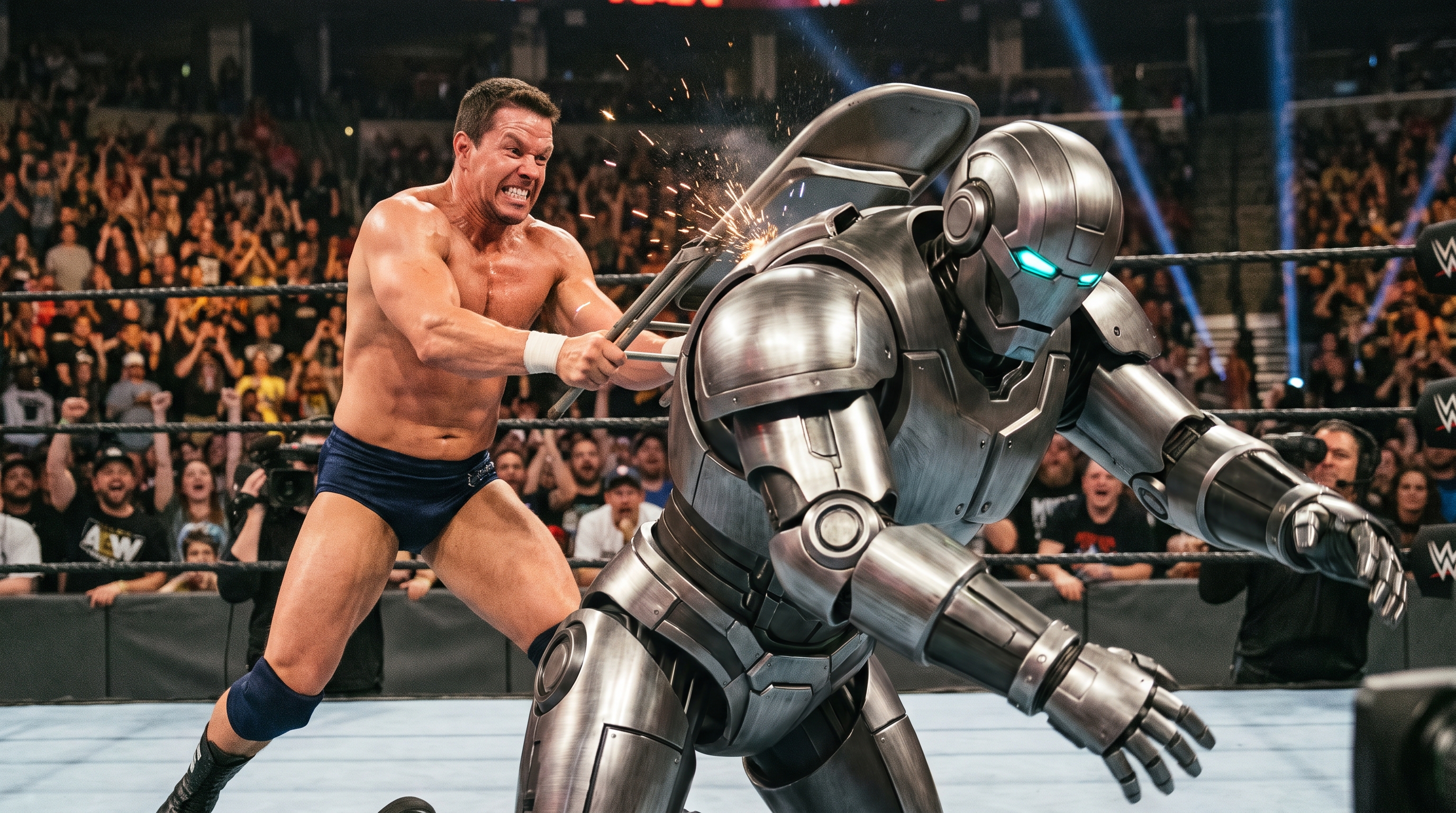
In 1984, a 20/20 reporter named John Stossel stood in a locker room and told professional wrestler David Schultz, on camera, that he thought wrestling was fake. Schultz slapped him to the floor. Twice. Real slaps, a real concussion claim, a real lawsuit.
Schultz wasn’t losing his temper. He was doing his job. Because in 1984, the most important rule in professional wrestling (more important than winning, more important than safety, more important than the law, apparently) was this: you never admit the show is a show.
Wrestling has a word for that rule. Kayfabe. And I want to take the time to explain it properly (not as a punchline, but as a system) because kayfabe is one of the most instructive ideas the entertainment business ever produced. Understood correctly, it draws a bright ethical line: the line between an illusion an audience agrees to and an illusion imposed on people who never consented to it. Wrestling lived its whole history on the right side of that line.
The AI industry is living on the wrong side of it right now.
What kayfabe actually is
Kayfabe comes out of the carnival circuits where American wrestling was born: carny slang, probably a mangled version of “be fake.” The carnival gave wrestling its whole hidden vocabulary, and you need four of those words to follow the rest of this: a staged event is a work. A real one is a shoot. The paying customer who believes is a mark. And a performer’s manufactured persona (the character, the costume, the act) is his gimmick.
Most people think kayfabe just means “the matches were scripted.” That’s the smallest part of it. Kayfabe was a total, industrial-scale discipline for maintaining a fictional world across every surface of the business, at all times, everywhere.
Consider what it actually demanded. Wrestlers who feuded in the ring could not be seen together outside it; sworn enemies traveled in separate cars and drank in separate bars, because one fan spotting them splitting a pizza could crack the illusion for an entire territory. Wrestlers stayed in character at the gas station, at the airport, at their kids’ schools; some worked their gimmick so completely that neighbors didn’t know their real names. When a storyline said a man was injured, he limped through the grocery store on his day off. When men were really hurt, promoters sometimes routed rivals to separate hospitals, in case anyone was watching. The announcers called scripted matches with the urgency of title fights. The “championships” had invented lineages recited like scripture. And when the business bled, it sometimes bled for real (razor blades palmed and drawn across the forehead) because real blood drew real money in service of a fake fight.
Breaking the code got you fined, blackballed, or slapped like Stossel. The system enforced itself, decade after decade, across thousands of performers who kept the secret better than most governments keep theirs.
Why would an industry go to those lengths? Because belief was the asset. Wrestling’s product was emotional stakes (the audience’s need to see the villain get what was coming to him) and the gate rose and fell with the intensity of that belief. Kayfabe wasn’t decoration on the business. Kayfabe was the business, the whole apparatus for protecting the single asset everything else depended on.
Why kayfabe is okay in wrestling, and this is the part that matters
Here’s where wrestling deserves more respect than it gets, and where the whole argument turns.
Over time, the audience figured it out. Of course they did. And then the remarkable thing happened: they kept coming. The marks became what the business calls smart marks: fans who know exactly how the trick works and choose to invest anyway, the way you cry at a movie you know is fiction, the way you gasp at a magician you know is palming the coin. Kayfabe matured from a secret into a covenant: you pretend it’s real, we’ll pretend it’s real, and together we’ll feel something real.
That covenant rests on two conditions, and I want to name them precisely, because they are the entire ethical foundation under any illusion.
The first condition is consent. The wrestling audience chooses the fiction. They buy the ticket knowing (at first suspecting, eventually knowing outright) that the outcome is authored. The suspension of disbelief is theirs to give, and they give it freely, every show, because the fiction is the point. Nobody is deceived in any meaningful sense, because deception requires a victim who believes something false to their detriment, and there is none in the building.
The second condition is stakes, or rather the absence of them. Walk the worst case for a wrestling fan: he believes with his whole heart, the match is a work, and… nothing. He paid for an evening of spectacle and received an evening of spectacle. The illusion and the product are the same object, delivered simultaneously, consumed completely by the time the house lights come up. The bet settles the same night, in full. He goes home with exactly what he came for, lighter only by the ticket price he’d have paid anyway. Kayfabe never reached into his life, his savings, his livelihood, his safety. It couldn’t. It wasn’t built to.
Consent plus no stakes: that’s why kayfabe in wrestling isn’t a lie in any sense that should trouble anyone. It’s theater with the fourth wall welded shut: a collaborative fiction, arguably the most successful one in entertainment history.
And the proof that the fiction was never load-bearing came in 1989, when Vince McMahon’s WWF stood before the New Jersey State Senate and admitted, on the record, that wrestling was entertainment with predetermined outcomes. (Why confess the industry’s most sacred secret? To escape athletic-commission oversight and taxes. Even kayfabe’s death was a business decision.) The old-timers thought the admission would kill wrestling. Instead the business boomed (the most profitable era in its history followed) because the audience had never actually needed the lie. They needed the athleticism, the storytelling, the spectacle. Those were real all along. The product could carry the truth.
Hold every piece of that on the table: the covenant, the two conditions, and what happened when the truth came out. Now let’s talk about my industry.
Business kayfabe: the same machinery, minus the consent, plus the stakes
Walk any feed, any conference floor, any vendor pitch deck in 2026 and you will see wrestling’s machinery running at full capacity. The gimmick: “autonomous AI agents, out of the box: deploys in minutes, replaces a department, no technical expertise required.” The worked match: the product demo, rehearsed until it looks spontaneous, run on curated data down the happy path. The promo: the keynote promising the end of work as we know it, delivered with the exact cadence of a man in sunglasses yelling about SummerSlam: enormous claimed stakes, conveniently untestable until after you’ve bought in. The announcers: an ecosystem of influencers and breathless analysts selling the angle. Even the locker-room code is intact: nobody publishes their failed deployments. Never expose the business.
And the scale of the act is measured, not alleged. Gartner (the industry’s own referee, nobody’s idea of an anti-AI activist) estimates that of the thousands of vendors currently selling “agentic AI,” only about 130 possess genuine agentic capability. It coined a term for the rest: agent washing. A chatbot repackaged in new tights. In wrestling they called that a gimmick change, and they did it for the same reason: the old act stopped drawing.
So the machinery is identical. Now run the two conditions.
Consent. The business owner sitting across from an AI vendor has made no covenant. She is not a smart mark choosing a fiction; she believes she is watching a shoot (a factual claim about a tool’s capability) because that is what a sales meeting is supposed to be. There is no wink, no shared understanding, no fourth wall. She is evaluating whether to spend real money based on what she’s being told. The suspension of disbelief is not hers to give, because nobody told her there was disbelief to suspend. Take wrestling’s illusion and subtract the audience’s knowing participation, and it stops being theater. An illusion without consent is just a deception with production values.
Stakes. Now walk her worst case, the way we walked the wrestling fan’s. She believes the promo. She buys. And unlike the fan, she does not receive the illusion as the product: the demo was the show, but the product has to perform Monday morning, in her real business, against real invoices and real customers, long after the lights are down. When it can’t, she doesn’t go home lighter by a ticket price. She eats the capital, the burned staff hours, the operational disruption, the political damage to whoever championed the project. For a small or mid-sized business, a failed six-figure “AI transformation” is not a rough quarter. It can be the business. Wrestling’s kayfabe settled its account the same night, in full. Business kayfabe writes a check the product has to cash later, and MIT researchers found roughly 95% of enterprise generative AI pilots failing to deliver measurable ROI, while Gartner projects over 40% of agentic AI projects canceled by the end of 2027. That is the sound of those checks bouncing, at scale.
Fail the first condition and you have something unethical. Fail both and you have something unethical and destructive. That’s the whole indictment, and it doesn’t require a single metaphor to stand up; the metaphor just shows you the machinery. Let me show you how far the machinery actually goes, with three cases. Only three, each documented past argument, each marking a different point on the line.
How far the costume goes. An app called Nate raised over $40 million marketing AI-powered shopping: one tap, and its proprietary AI completes the purchase. In April 2025 federal prosecutors charged the founder with fraud, alleging the actual automation rate was effectively zero. The “AI” was hundreds of human contractors in overseas call centers, manually clicking through checkouts while investors were told a machine was doing it. Sit with that: it’s the carnival act, unchanged: a human behind a curtain, wearing a robot gimmick, sold to marks as a shoot. Except the carnival never got indicted, because the carnival’s audience was in on the joke. Nate’s wasn’t.
How the hype outruns even honest products. Not every work is a fraud; that’s what makes this insidious. In early 2024, Klarna announced its AI assistant was doing the work of 700 customer-service agents, and that claim rocketed around the world and became the proof-point slide in a thousand other vendors’ decks. By mid-2025, Klarna’s own CEO publicly admitted the push had gone too far: quality dropped, customers wanted humans, and the company began hiring people back. No enforcement action, no fraud, just a promo the product couldn’t cash. But watch the asymmetry, because this is the mechanism that poisons everything: the “700 agents” promo is still cited constantly. The correction travels at a fraction of the speed. In kayfabe terms, the angle got over and the truth never did, and every business that bought an agent platform on the strength of that angle absorbed the gap between the two.
And what it looks like when the stakes are highest. Evolv Technologies sold AI-powered weapons detection to schools (marketed, at the peak of the pitch, as reliably catching weapons at the door). In November 2024 the FTC charged that Evolv deceived buyers about what the systems could actually detect; independent testing found scanners missing knives while flooding staff with false alarms. The settlement bars the unsupported claims and let school customers cancel their contracts. Understand what the kayfabe sold here: not efficiency, not ROI. Safety theater at a school entrance, purchased with public money by districts who believed a shoot was happening, staffed by parents who believed it too. Wrestling’s illusion never had stakes. This illusion had children behind it.
One line, from a carnival act to a walked-back boast to a school door. That’s the range of business kayfabe, and every point on it fails the same two conditions.
I’ve watched this poison a well before
I don’t hold this position theoretically. I spent years in the red light therapy industry, and I watched exactly this dynamic nearly bury a technology that does real good for real people.
Red light therapy (photobiomodulation, if you want the term the research literature uses) is a legitimately effective modality, and its honest value lives where the evidence lives: pain, inflammation, recovery. For people who hurt every day, that’s not a marketing bullet. That’s getting your life back an hour at a time.
But the industry ran its kayfabe. Trumped-up claims first: somewhere along the way, sellers discovered that “lose weight while you lie there” moved more units than “reduce inflammation over a consistent protocol,” and the gimmick took over the category. Then the bad devices: underpowered panels with inflated specs, hardware that could never deliver a therapeutic dose no matter what the promo promised, sold interchangeably alongside legitimate equipment to buyers who had no way to tell a work from a shoot.
And the marks did exactly what unconsenting marks always do. They bought the gimmick, the gimmick didn’t deliver, and they drew the reasonable conclusion from what they were sold: this technology is junk. Not “that device was underpowered.” Not “that was the wrong use case.” The technology. The category. And they told everyone.
Who would have thought? You sell a pain and inflammation modality as a fat-melting machine, and when the fat doesn’t melt, the customer doesn’t file a nuanced complaint. He writes off the whole field, and he’s credible when he does it, because he has the receipts of his own disappointment. The honest operators then spent years digging the technology’s reputation out of a hole the gimmick sellers dug, one skeptical customer at a time. I was one of the people holding a shovel. I can tell you the exchange rate from experience: trust liquidates at gimmick speed and rebuilds at reality speed. Months to burn. Years to restore.
That is what business kayfabe does to an industry, and it’s why this isn’t just an ethics complaint. The lie doesn’t stay contained to the liar. Every failed overpromise manufactures a sincere, evidence-carrying evangelist against the technology itself, and the honest sellers inherit the skepticism the dishonest ones created. AI is running up that exact bill right now, at a scale red light therapy never touched.
The maddening part: AI doesn’t need the gimmick
Here’s what makes all of this so unnecessary. AI, honestly described, is the most significant capability expansion available to businesses in a generation. It can read, draft, summarize, and structure at volumes no staff could match. It can strip the repetitive cognitive load off your best people. It can turn the institutional knowledge buried in your documents and inboxes into something searchable and usable. Built into a well-designed system, it compounds: every process you instrument makes the next one easier to improve.
That’s a real product. It doesn’t need a costume. What it needs is the part of the pitch the costume exists to hide: the path. Process mapping before any tool is deployed, because you cannot automate a workflow you haven’t defined. Data readiness, because these systems are only as good as what they can see. Integration into your actual systems, not a demo tab beside them. Human oversight and feedback loops, because these systems drift and err and improve only when somebody’s watching. And iteration: months of tightening, not minutes of onboarding. Implementation, not installation.
There is no out-of-the-box. There is only a build. And anyone who walks into your business claiming otherwise has told you something categorically untrue before the meeting even starts.
Where kayfabe can’t survive
Notice something about every piece of kayfabe machinery we’ve walked through. The worked demo, the edited launch video, the keynote promo, the case study written like a press release: all of it depends on one structural ingredient, distance. Distance between the performer and the audience. Distance between the show and the delivery. A stage to perform on, an edit bay to cut in, a gap in time between the promise and the moment anyone can check it. Wrestling knew this cold; kayfabe was enforceable precisely because the audience was on the other side of the ropes. The work happens where the mark can’t touch it.
Close the distance and kayfabe dies. It has no other habitat.
This is why we built AI Actualized the way we did. We get our hands in the soil. We come into the business itself (into your workflows, your systems, your data, with you in the room) and we do the work in front of you while you watch it happen. Not a demo of the thing. The thing. Built live, in your environment, on your actual invoices and your actual customer messages, breaking where it breaks and getting fixed where it gets fixed, in plain view.
I want to be precise about what that posture does, because it’s not a personality trait and it’s not a marketing promise. It’s a structural constraint. There is no way to engineer deception in that scenario. You cannot run a worked match when the audience is standing in the ring with you. There’s no curtain to put the humans behind, no edit to hide the failures in, no gap between the show and the product where a gimmick could live, because the show is the product, assembled in front of the one person with every incentive and every ability to check it against reality in real time. When something doesn’t work, the client sees it not work, and then sees what fixing it actually takes. That’s not a risk of the model. That’s the point of the model. The transparency isn’t a virtue we advertise. It’s a condition we can’t escape, and we chose it on purpose.
Which gives every business owner reading this a test sharper than any question you could ask a vendor: look at where their model puts you. On the other side of the ropes, watching a produced performance and waiting to find out later what you actually bought? Or in the ring, watching the real work happen in your own systems? Kayfabe needs the first arrangement to exist. It cannot survive the second. A vendor who structures the engagement so you can watch has removed their own ability to work you, and a vendor who keeps you at showtime distance has kept it, whatever their intentions.
Proximity is the test. Demand it.
Breaking kayfabe
Remember how wrestling’s story ends. The business told the truth (for self-interested reasons, but it told the truth) and the truth didn’t kill it. The truth set off the most profitable era in its history, because the product was real underneath the fiction and the audience respected being leveled with.
That option is open to AI, and the window is still open with it. The technology is real underneath this fiction too, realer than wrestling’s ever was. The honest pitch (here’s what it does, here’s the build required, here’s the timeline, here’s what stays human) closes slower and holds forever, and it produces the only assets that survive a hype collapse: deployments that work, and customers who vouch.
So, plainly. If you’re selling AI: break kayfabe. You are not protecting the business by working the gimmick; you are spending the technology’s credibility as your promotional budget, and the bill lands on all of us. And if you’re buying: learn to spot a work. The moment someone says “out of the box,” ask them to name the specific workflows it will touch in your business, the data it will need, who maintains it, and what the first ninety days look like. A real builder gets more specific under those questions. A gimmick gets louder.
Wrestling earned its fiction. The audience consented, the stakes were nothing, and the show delivered exactly what it sold. The AI industry has earned no such license; it’s working unconsenting marks with real money on the table, and calling it marketing.
AI doesn’t need protecting from the truth. It needs protecting from its own promoters.
Documented cases and figures: DOJ/SEC fraud charges against Nate’s founder, April 2025 (automation rate “effectively zero”); Klarna’s public reversal of its “700 agents” AI claims, 2025; FTC action against Evolv Technologies, November 2024; Gartner on agent washing (~130 genuine of thousands) and 40%+ agentic project cancellations projected by 2027; MIT’s 2025 “GenAI Divide” report (~95% of enterprise GenAI pilots failing to deliver measurable ROI); WWF testimony before the New Jersey State Senate, 1989.